Seville Airport
Check-in at the airport
Check-in is the process by which you notify the airline that you are ready to travel. During check-in, the airline verifies your booking, assigns your seat and checks in any hold baggage, if applicable.
Upon arrival at Seville Airport, go to your airline’s assigned check-in counter and present your ID card or passport, together with your ticket or booking reference (the six-character locator code provided when you made your reservation).
If you have baggage to check in, it will be weighed and tagged at the counter. Once the process is complete, you will receive your boarding pass showing your departure time, terminal, boarding area and gate, along with the baggage receipt.
Check-in and boarding: useful information
Passengers should arrive at the check-in counter at least:
- 3 hours before departure for non-Schengen flights. Non-EU passengers may experience additional passport control processing under the EU Entry/Exit System (EES). Allow extra time before departure.
- 1.5-2 hours before departure for Schengen and domestic flights.
- During peak travel periods or special events, queues may be longer than usual.
- Keep an eye on the flight information screens, as gate changes can occasionally occur at short notice.
- If you have already checked in online and have your boarding pass, you may be able to use a baggage drop-off counter if you are travelling with checked luggage.
- Never leave your baggage unattended and do not carry items or luggage for other people, as you are responsible for its contents.
- Before leaving the check-in counter, make sure you have all your belongings with you, including your travel documents, boarding pass and ID or passport.
- Do not carry open or unsealed liquids, gels or drinks, as they may be confiscated at security. Please check current security regulations before travelling.
- Make sure you do not carry open or unsealed liquids, gels, drinks, cans or soft drinks, as they may be rejected at the security checkpoint. Please refer to the regulations and security measures in this regard.
Online check-in
To avoid queues at the airport, many airlines offer online check-in from home, the office or a mobile device.
It is usually available 24 to 48 hours before departure and closes 1 to 2 hours before the flight. It allows the airline to confirm your check-in and, in many cases, lets you choose your seat.
If you expect to exceed your baggage allowance, some airlines allow you to pre-purchase additional baggage during online check-in, often at lower rates than at the airport.
How does online check-in work?
Visit your airline’s website or app and look for the online check-in section. In many cases, you only need your booking reference and surname. Follow the instructions to print your boarding pass or receive a mobile boarding pass (BCBP).
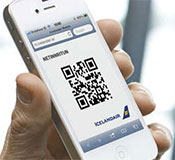
The mobile boarding pass BCBP
Mobile boarding pass (BCBP)
A Bar Coded Boarding Pass (BCBP) is a digital boarding pass containing all essential passenger and flight information in a 2D barcode that can be scanned at the airport.
Check-in counters and boarding gates
Check-in counters:
Departures hall, level 1.
35 domestic and international check-in counters.
1 Special baggage desk.
Security and passport controls:
Departures hall, level 1.
All passengers must pass through security screening before entering the boarding area. This includes walking through a metal detector and having hand luggage screened by X-ray.
Passengers may be asked to remove shoes or bulky outerwear. Passengers may be required to remove laptops, tablets and liquids from hand luggage, in accordance with current security procedures.
Depending on your destination, an additional passport or security control may be required before boarding.
Want to skip the security queues? Fast Lane reduces waiting time time and allows quicker access to the boarding area or VIP lounges.
Boarding area:
Located on Level 1, the boarding area has 19 gates for domestic and international flights. Some gates are connected to the aircraft by passenger boarding bridges, while others are used for remote boarding. Depending on your destination, additional passport control may be required before boarding.
Boarding gates:
Gates A1-A2, A3-A4, A5-A6.
Gates B11, B12, B13, B14, B15-B16, B17, B18-C21.
Gates C22, C23, C24-C25.
Flight classification: Schengen and others
Flights are classified by origin or destination into three groups: Schengen, EU Non-Schengen, and Third Countries.
Schengen Associated Countries:
Flights to or from countries that have signed the Schengen Agreement. Citizens of these countries can move freely across internal borders. Both international Inter-Schengen flights and domestic flights are subject to the Schengen Agreement. The Schengen Area includes: Austria, Belgium, Bulgaria, Croatia, Denmark, Estonia, Finland, France, Greece, Hungary, Iceland, Italy, Latvia, Liechtenstein, Lithuania, Luxembourg, Malta, Norway, Netherlands, Poland, Portugal, the Czech Republic, Romania, Slovenia, Slovakia, Spain, Sweden, and Switzerland.
Non Schengen EU Countries:
Flights to or from countries within the European Union that have not signed the Schengen Agreement. Citizens of these countries are not allowed to move freely across the internal Schengen borders: Ireland and Cyprus.
Entry/Exit System (EES) notice
Non-EU travellers may be subject to the EU’s Entry/Exit System (EES), which records entries and exits digitally and may require fingerprint and facial biometric registration. This process may increase waiting times at passport control, so passengers on non-Schengen flights should allow extra time
Third Countries:
Flights to or from countries that are not part of the European Union and have not signed the Schengen Agreement.
Further information
For more information about required travel documents and arrival formalities at your destination, visit aeropuertosenred.com.

